
Trinity College London Classical Guitar · Grade 2
Trinity Classical Grade 2 guitar
Two-part textures and the first half-barre shapes.
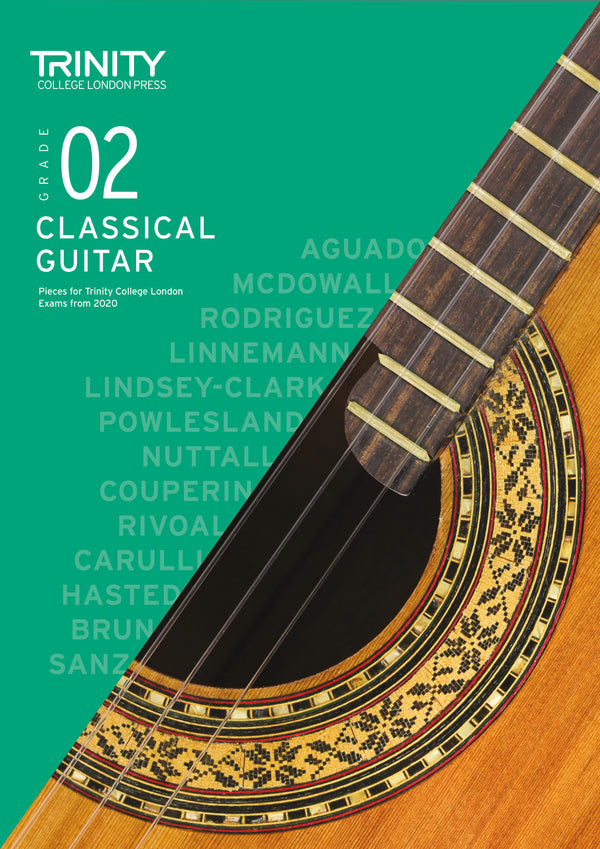
Trinity exams are taken digitally by default — recorded and submitted online — with in-person exams arranged for students who prefer them.
Set pieces
Tap any piece to open its own page with a play-along video, amp settings and practice tips. You'll still need the official grade book for the notation.
Every piece across all Trinity Classical Grade 2 books(25)
- Waltz— AguadoClassical Guitar Exam Pieces from 2020: Grade 2 — Trinity TCL019295 Play
- Le paon— BrunClassical Guitar Exam Pieces from 2020: Grade 2 — Trinity TCL019295 Play
- Danse paysanne— CarulliClassical Guitar Exam Pieces from 2020: Grade 2 — Trinity TCL019295 Play
- Tirandosaurus Rex— CottamZebracadabra — ESG 077 Play
- Le petit rien (duet)— Couperin, arr. PowleslandClassical Guitar Exam Pieces from 2020: Grade 2 — Trinity TCL019295 Play
- New Day— EythorssonRaise the Bar Guitar: Initial-Grade 2 — Trinity TCL016553 Play
- La princesse de la paix— FimbelLa paix des étoiles — Productions d'Oz DZ2599 Play
- Regular Reggae— HastedClassical Guitar Exam Pieces from 2020: Grade 2 — Trinity TCL019295 Play
- Gavotte or Tanz in der Burg— KirschbaumMelodie und Bass vol. 1 — Hubertus Nogatz KN1012 Play
- Barcarolle— Lindsey-ClarkClassical Guitar Exam Pieces from 2020: Grade 2 — Trinity TCL019295 Play
- By the Fireside— Lindsey-ClarkSolo Now! vol. 1 — Chanterelle ECH2101 Play
- Killeybegs Jig— LinnemannClassical Guitar Exam Pieces from 2020: Grade 2 — Trinity TCL019295 Play
- Spanish Nocturne— McDowallClassical Guitar Exam Pieces from 2020: Grade 2 — Trinity TCL019295 Play
- The Mojave— NuttallClassical Guitar Exam Pieces from 2020: Grade 2 — Trinity TCL019295 Play
- Nuit étoilée— OgawaThe Many Faces of the Guitar vol. 1 — Productions d'Oz DZ1041 Play
- Valse slave— OurkouzounovMise en scène — Lemoine HL26826 Play
- In the Half-Light— PowleslandClassical Guitar Exam Pieces from 2020: Grade 2 — Trinity TCL019295 Play
- La cumparsita (duet)— Rodriguez, arr. CracknellClassical Guitar Exam Pieces from 2020: Grade 2 — Trinity TCL019295 Play
- Paradetas— Sanz, arr. PowleslandClassical Guitar Exam Pieces from 2020: Grade 2 — Trinity TCL019295 Play
- Etude, op. 44 no. 2— SorRaise the Bar Guitar: Initial-Grade 2 — Trinity TCL016553 Play
- Czardas— Sor, arr. HartogString Walker — Alsbach ALB10514 Play
- A rosa vermelha (duet)— Trad., arr. RivoalClassical Guitar Exam Pieces from 2020: Grade 2 — Trinity TCL019295 Play
- Unos Ojos Negros (duet)— Trad., arr. RivoalChansons et danses d'Amérique latine vol. A — Lemoine HL25161 Play
- Malagueña— Trad., arr. SzordikowskiMy First Concert — Schott ED22050 Play
- Petit air chromatique— VachezÇa ne manque pas d’airs! — Doberman DO977 Play
Books and exam booking
The Trinity Grade 2 book and the exam booking both come from Trinity College London directly.
Technical work at Grade 2
- Two-octave scales in common keys
- Half barre
- Slurs (ligados) ascending and descending
- Wider arpeggio patterns
What's in the exam
- Three pieces from the syllabus
- Technical work
- One supporting test
- Musical knowledge
Trinity Classical Grade 2 technical work in full
Everything below is published in Trinity's book Guitar Scales, Arpeggios and Studies from 2016: Initial–Grade 5. You always play the technical exercise, then choose one of: scales & arpeggios set A, scales & arpeggios set B, or the studies. Tell the examiner your choice on the submission form.
1. Technical exercise
Technical exercise in D major (♩ = 86) — music may be used.
2. Scales & arpeggios — set A
From memory, mf.
- F major scale and arpeggio — one octave, p fingering, tirando. Minimum tempi: scale ♩ = 62, arpeggio ♩ = 94
- D melodic minor scale and arpeggio — one octave, im fingering
- Chromatic scale starting on G — apoyando or tirando (your choice). Minimum tempo ♩ = 94
3. Scales & arpeggios — set B
From memory, mf.
- F major scale and arpeggio — one octave, p fingering, tirando. Minimum tempi: scale ♩ = 62, arpeggio ♩ = 94
- A harmonic minor scale and arpeggio — one octave, im fingering
- Chromatic scale starting on G — apoyando or tirando (your choice). Minimum tempo ♩ = 94
4. Studies
Choose and perform two studies, each from a different group. Music may be used.
Group 1 — for tone and phrasing
- Skater’s Waltz
- Linecraft
Group 2 — for articulation
- Tin Drum
- Porcupine Stomp
Group 3 — for idiomatic elements
- Lost and Found
- Mystic Drummer