
Trinity College London Classical Guitar · Grade 4
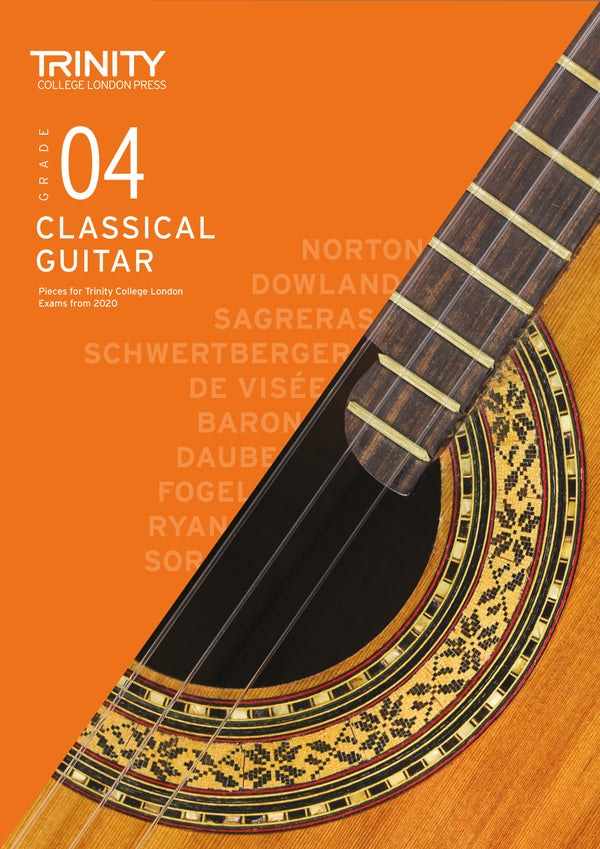
Trinity Classical Grade 4 guitar
Repertoire from the Renaissance through to the twentieth century.
Trinity exams are taken digitally by default — recorded and submitted online — with in-person exams arranged for students who prefer them.
Set pieces
Tap any piece to open its own page with a play-along video, amp settings and practice tips. You'll still need the official grade book for the notation.
Every piece across all Trinity Classical Grade 4 books(31)
- Rumba por Givi (from Flamenco Suite)— AliGraded Repertoire for Guitar book 2 — Mel Bay 20038 Play
- Allemande (from Sonata for Two Guitars) (duet)— BaronClassical Guitar Exam Pieces from 2020: Grade 4 — Trinity TCL019318 Play
- Bourrée— BaronMy First Concert — Schott ED22050 Play
- Glissaccatura— BaulchRaise the Bar Guitar: Grades 3-5 — Trinity TCL016560 Play
- Waltz for a Sad Cloud (no. 2 from 6 Children's Pieces)— Bogdanović6 Children's Pieces or Learn & Conquer Guitar Repertoire with Xuefei Yang, children’s book 1 — Doberman DO734 or DO961 Play
- Étude no. 4— BrouwerÉtudes simples vol. 1 — Eschig ME00799700 Play
- L’éléphant— BrunMusicanimales — Lemoine HL25247 Play
- Etude no. 7 in A minor— Carcassi25 Melodic and Progressive Studies, op. 60 — Chanterelle ECH0470 Play
- Sicilienne, op. 34 no. 2— CarulliFirst Repertoire for Solo Guitar book 1 — Faber 0571507093 Play
- Menuets I & II (from Partie in A major)— Daube, arr. WillisClassical Guitar Exam Pieces from 2020: Grade 4 — Trinity TCL019318 Play
- Orlando Sleepeth— Dowland, arr. HegelClassical Guitar Exam Pieces from 2020: Grade 4 — Trinity TCL019318 Play
- Rainy Impression— DrożdżowskiAll Year Round with the Guitar — Euterpe EU1003 Play
- On Joe's Deck— DyensSeparately or Les 100 de Roland Dyens vol. 1 — Productions d'Oz DZ1901 or DZ2201 Play
- Village Blackbird Blues— FogelClassical Guitar Exam Pieces from 2020: Grade 4 — Trinity TCL019318 Play
- Petit air d'Argentine— KleynjansRaise the Bar Guitar: Grades 3-5 — Trinity TCL016560 Play
- Danza del arpa— Lindsey-ClarkSimply Latin — Montague MM121 Play
- Milonga— MuroBasic Pieces vol. 2 — Chanterelle ECH0782 Play
- Line by Line— Norton, arr. NestorClassical Guitar Exam Pieces from 2020: Grade 4 — Trinity TCL019318 Play
- In Good Company— RobertsNew Beginnings — Trinity TCL019134 Play
- Spice Trail— RyanClassical Guitar Exam Pieces from 2020: Grade 4 — Trinity TCL019318 Play
- Nostalgia: petite mélodie (from Tres piezas fáciles, op. 19)— SagrerasClassical Guitar Exam Pieces from 2020: Grade 4 — Trinity TCL019318 Play
- La caridad (duet)— Saumell19 Contradanzas — Lemoine HL29261 Play
- Bossa-Nova Breeze— SchwertbergerClassical Guitar Exam Pieces from 2020: Grade 4 — Trinity TCL019318 Play
- Calderas— SmithAtmospheres & Adventures — Trinity TCL019127 Play
- Andante (no. 2 from 24 leçons progressives, op. 31)— SorClassical Guitar Exam Pieces from 2020: Grade 4 — Trinity TCL019318 Play
- Etude in C major— StachakCharacteristic Études vol. 1 — Euterpe EU1801 Play
- Malborough— Trad., arr. GagnonLearn & Conquer Guitar Repertoire with Xuefei Yang, beginner book 1 — Doberman DO962 Play
- Tango (with repeats) (from Capullos de Abril)— ViñasCollected Guitar Works — Chanterelle ECH0443 Play
- Gavotte (from Suite in D minor) (first repeat to be played)— de Visée, arr. ScheitClassical Guitar Exam Pieces from 2020: Grade 4 — Trinity TCL019318 Play
- Whirligig— WatersSolo Now! vol. 2 — Chanterelle ECH2102 Play
- Romance (no. 14 from 20 Epigrammes)— ZenamonGraded Repertoire for Guitar book 2 — Mel Bay 20038 Play
Books and exam booking
The Trinity Grade 4 book and the exam booking both come from Trinity College London directly.
Technical work at Grade 4
- Scales in thirds and octaves
- Extended barre stamina
- Ornamentation and trills
- Tone colour: ponticello and tasto
What's in the exam
- Three pieces from the syllabus
- Technical work
- One supporting test
- Musical knowledge
Trinity Classical Grade 4 technical work in full
Everything below is published in Trinity's book Guitar Scales, Arpeggios and Studies from 2016: Initial–Grade 5. You always play the technical exercise, then choose one of: scales & arpeggios set A, scales & arpeggios set B, or the studies. Tell the examiner your choice on the submission form.
1. Technical exercise
Technical exercise in A major (♩ = 130) — music may be used.
2. Scales & arpeggios — set A
From memory, mf.
- E major scale and arpeggio — two octaves, scale im. Minimum tempi: scale ♩ = 82, arpeggio ♩. = 44
- D harmonic minor scale and arpeggio — two octaves, scale ma
- Chromatic scale starting on F — two octaves, im
- Dominant 7th arpeggio in the key of D major — ppimim…, tirando. Minimum tempo ♩ = 66
3. Scales & arpeggios — set B
From memory, mf.
- B♭ major scale and arpeggio — two octaves, scale im. Minimum tempi: scale ♩ = 82, arpeggio ♩. = 44
- G melodic minor scale and arpeggio — two octaves, scale ma
- Chromatic scale starting on F — two octaves, im
- Dominant 7th arpeggio in the key of D major — ppimim…, tirando. Minimum tempo ♩ = 66
4. Studies
Choose and perform two studies, each from a different group. Music may be used.
Group 1 — for tone and phrasing
- Half Moon
- Flamenco Fantasy
Group 2 — for articulation
- River
- And Relax…
Group 3 — for idiomatic elements
- Dark Maze
- Sorrow