
Trinity College London Classical Guitar · Initial
Trinity Classical Initial guitar
A gentle first exam — short pieces in first position with free strokes.
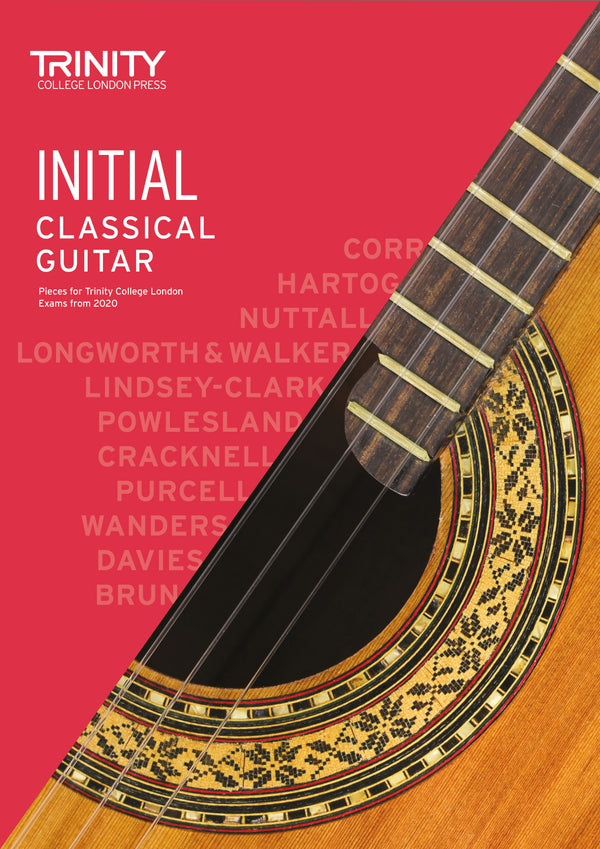
Trinity exams are taken digitally by default — recorded and submitted online — with in-person exams arranged for students who prefer them.
Set pieces
Tap any piece to open its own page with a play-along video, amp settings and practice tips. You'll still need the official grade book for the notation.
Every piece across all Trinity Classical Initial books(19)
- La tortue— BrunClassical Guitar Exam Pieces from 2020: Initial — Trinity TCL019271 Play
- Gypsy Dance— CorrClassical Guitar Exam Pieces from 2020: Initial — Trinity TCL019271 Play
- Luna— CostantinoThe Many Faces of the Guitar vol. 1 — Productions d'Oz DZ1041 Play
- Inca Dawn— CracknellClassical Guitar Exam Pieces from 2020: Initial — Trinity TCL019271 Play
- Finnish Folk Song— DaviesClassical Guitar Exam Pieces from 2020: Initial — Trinity TCL019271 Play
- Morning— GriegRaise the Bar Guitar: Initial-Grade 2 — Trinity TCL016553 Play
- La campanella— HartogClassical Guitar Exam Pieces from 2020: Initial — Trinity TCL019271 Play
- Andante in A minor— IntilangeloGuitar Basics Workouts — Faber 0571536883 Play
- Helping Hand (duet)— Lindsey-ClarkClassical Guitar Exam Pieces from 2020: Initial — Trinity TCL019271 Play
- La colombina— Longworth & WalkerClassical Guitar Exam Pieces from 2020: Initial — Trinity TCL019271 Play
- The Bells of Dawn (duet)— NuttallClassical Guitar Exam Pieces from 2020: Initial — Trinity TCL019271 Play
- Pirates— PowleslandClassical Guitar Exam Pieces from 2020: Initial — Trinity TCL019271 Play
- Rigadoon (duet)— Purcell, arr. PowleslandClassical Guitar Exam Pieces from 2020: Initial — Trinity TCL019271 Play
- Exercise 13, op. 35 (duet)— Sor, arr. KenyonABC Guitar — Jacaranda JM02-003 Play
- The Rising Sun— Trad., arr. NuttallClassical Guitar Exam Pieces from 2020: Initial — Trinity TCL019271 Play
- Aura Lee— Trad., arr. PowleslandClassical Guitar Exam Pieces from 2020: Initial — Trinity TCL019271 Play
- Ojos Azules (duet)— Trad., arr. RivoalChansons et danses d'Amérique latine vol. C — Lemoine HL25163 Play
- First Steps— TrompRaise the Bar Guitar: Initial-Grade 2 — Trinity TCL016553 Play
- Salsa Party— WandersClassical Guitar Exam Pieces from 2020: Initial — Trinity TCL019271 Play
Books and exam booking
The Trinity Initial book and the exam booking both come from Trinity College London directly.
Technical work at Initial
- Right-hand free stroke (tirando) with i and m
- Open string exercises
- C major and A minor in first position
- Simple thumb-and-fingers arpeggios
What's in the exam
- Three pieces from the syllabus
- Technical work
- One supporting test
- A short musical knowledge conversation
Trinity Classical Initial technical work in full
Everything below is published in Trinity's book Guitar Scales, Arpeggios and Studies from 2016: Initial–Grade 5. You always play the technical exercise, then choose one of: scales & arpeggios set A, scales & arpeggios set B, or the studies. Tell the examiner your choice on the submission form.
1. Technical exercise
Technical exercise in C major (♩ = 80) — music may be used.
2. Scales & arpeggios — set A
From memory, mf.
- G major scale and arpeggio — to the 5th, im fingering. Scale apoyando or tirando (your choice), arpeggio tirando. Minimum tempi: scale ♩ = 88, arpeggio ♩ = 100
3. Scales & arpeggios — set B
From memory, mf.
- A minor scale and arpeggio — to the 5th, im fingering. Scale apoyando or tirando (your choice), arpeggio tirando. Minimum tempi: scale ♩ = 88, arpeggio ♩ = 100
4. Studies
Choose and perform two studies, each from a different group. Music may be used.
Group 1 — for tone and phrasing
- Star Gazer
- Playground Games
Group 2 — for articulation
- Submarine
- Stop It!
Group 3 — for idiomatic elements
- Ice Breaker
- Cross String Thing