
Trinity College London Classical Guitar · Grade 6
Trinity Classical Grade 6 guitar
Concert repertoire with real interpretive demands.
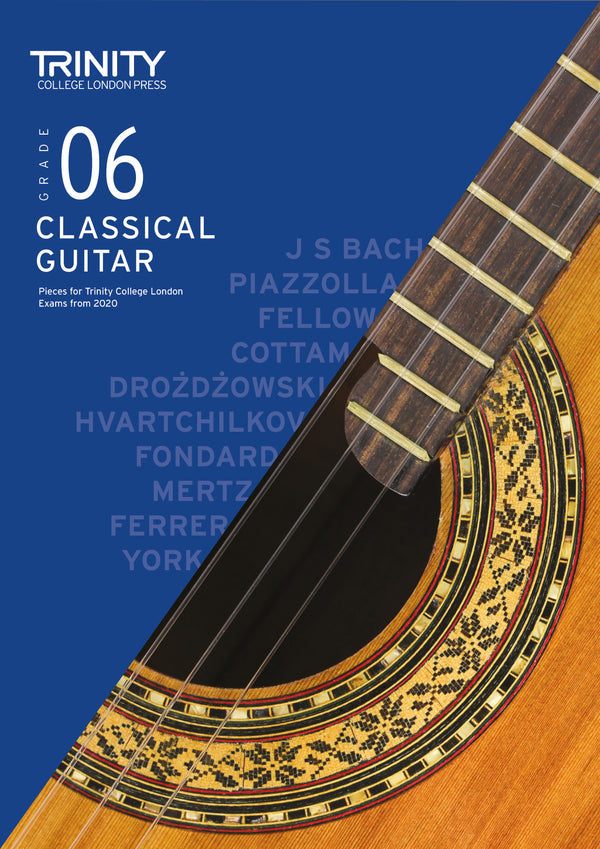
Trinity exams are taken digitally by default — recorded and submitted online — with in-person exams arranged for students who prefer them.
Set pieces
Tap any piece to open its own page with a play-along video, amp settings and practice tips. You'll still need the official grade book for the notation.
Every piece across all Trinity Classical Grade 6 books(30)
- Group ABourrée (from Lute Suite in E minor, BWV 996)— Bach, J S, ed. KoonceThe Solo Lute Works — Kjos WG100 Play
- Group ASarabande (from Partita no. 1 for solo violin, BWV 1002)— Bach, J S, arr. EriksonClassical Guitar Exam Pieces from 2020: Grade 6 — Trinity TCL019332 Play
- Group AAllegretto in A (no. 29 from 50 Progressive Exercises)— CarcassiCarcassi Guitar Method, op. 59 — Fischer GT216 Play
- Group ARomanze (from Sonate, op. 21 no. 3)— CarulliStars of Classical Guitar vol. 2 — Doblinger DOBL35922 Play
- Group AEtude, op. 38 no. 4— CosteRaise the Bar Guitar: Grades 6-8 — Trinity TCL016577 Play
- Group ACan She Excuse— DowlandSolo Works for Guitar vol. 2 — Universal UE16712 Play
- Group AEl afectuoso (no. 3 from Colección 4a)— FerrerClassical Guitar Exam Pieces from 2020: Grade 6 — Trinity TCL019332 Play
- Group AValse suisse— FondardClassical Guitar Exam Pieces from 2020: Grade 6 — Trinity TCL019332 Play
- Group ACapriccio— MertzClassical Guitar Exam Pieces from 2020: Grade 6 — Trinity TCL019332 Play
- Group ACanarios— SanzAnthology of Selected Pieces — Schott ED12386 Play
- Group AWaltz (no. 2 from 6 Petites Pièces, op. 32)— SorThe Guitarist's Collection book 1 — Mayhew 3611140 Play
- Group AMalagueña— TárregaWorks for Guitar vol. 3 — Bèrben B1533 Play
- Group ARecuerdo de la costa— ViñasCollected Guitar Works — Chanterelle ECH0443 Play
- Group APassacaille— de ViséeThe Baroque Book — Chanterelle ECH2111 Play
- Group BPromise— BloorPraise - Prayer - Promise — Productions d'Oz DZ4013 Play
- Group BOmaggio a Mangoré, no. 2— BrouwerNuevos estudios sencillos — Chester CH64273 Play
- Group BAndantino campestre— Castelnuovo-TedescoRaise the Bar Guitar: Grades 6-8 — Trinity TCL016577 Play
- Group BO Pussy My Love!, no. 6— DodgsonOde to the Guitar — Ricordi RICL00011400 Play
- Group BWinter Story— DroźdźowskiClassical Guitar Exam Pieces from 2020: Grade 6 — Trinity TCL019332 Play
- Group BBabybaião— DyensSeparately or Les 100 de Roland Dyens vol. 1 — Productions d'Oz DZ1907 or DZ2201 Play
- Group BNo Man's Land— FellowClassical Guitar Exam Pieces from 2020: Grade 6 — Trinity TCL019332 Play
- Group BDélia, op. 272— KleynjansDélia, op. 272 — Productions d'Oz DZ1687 Play
- Group BEntre azules— MontesNueve preludios azules — Trinity TCL019110 Play
- Group BTorija— Moreno TorrobaCastles of Spain vol. 1 — GSP 074 Play
- Group BLamentoso, no. 5— OurkouzounovCinq nuances modales — Doberman DO1039 Play
- Group BEl viaje— Piazzolla, arr. RyanClassical Guitar Exam Pieces from 2020: Grade 6 — Trinity TCL019332 Play
- Group BKalamatianos— Trad., arr. CottamClassical Guitar Exam Pieces from 2020: Grade 6 — Trinity TCL019332 Play
- Group BGeneral's Mandate— Trad., arr. HvartchikovClassical Guitar Exam Pieces from 2020: Grade 6 — Trinity TCL019332 Play
- Group BLet Go— Verdery11 Etudes or Learn & Conquer Guitar Repertoire with Xuefei Yang, intermediate book 1 — Doberman DO539 or DO963 Play
- Group BLullaby— YorkClassical Guitar Exam Pieces from 2020: Grade 6 — Trinity TCL019332 Play
Books and exam booking
The Trinity Grade 6 book and the exam booking both come from Trinity College London directly.
Technical work at Grade 6
- Three-octave scales
- Tremolo studies
- Artificial harmonics
- Advanced counterpoint and voicing
What's in the exam
- Three pieces from the syllabus
- Technical work
- One supporting test
- Musical knowledge
Trinity Classical Grade 6 technical work in full
Everything below is published in Trinity's book Guitar Scales, Arpeggios and Studies from 2016: Grades 6–8. You always play the technical exercise, then choose one of: scales & arpeggios set A, scales & arpeggios set B, or the studies. Tell the examiner your choice on the submission form.
1. Technical exercise
Technical exercise in A♭ major (♩ = 126) — music may be used.
- Major tonal centre: major scale, then major arpeggio
- Minor tonal centre: harmonic minor scale, then minor arpeggio
2. Scales & arpeggios — set A
From memory, mf.
- G major tonal centre — two octaves, scale im apoyando. Minimum tempi: scales ♩ = 106, arpeggios ♩. = 58
- C♯ minor tonal centre — three octaves, scale ma tirando
- E major tonal centre — two octaves, scale im apoyando
- Chromatic scale starting on D♭ — two octaves, ma. Minimum tempo ♩ = 88
- E major scale in thirds — one octave, im
- G harmonic minor scale in sixths — one octave, pi/pm
- Diminished 7th arpeggio starting on C♯ — two octaves, ppimim…
3. Scales & arpeggios — set B
From memory, mf.
- D♭ major tonal centre — two octaves, scale im apoyando. Minimum tempi: scales ♩ = 106, arpeggios ♩. = 58
- G minor tonal centre — three octaves, scale ma tirando
- E minor tonal centre — three octaves, scale im apoyando
- Chromatic scale starting on D♭ — two octaves, ma. Minimum tempo ♩ = 88
- G major scale in octaves — one octave, pi/pm
- E harmonic minor scale in tenths — one octave
- Dominant 7th arpeggio in the key of C major — two octaves
4. Studies
Choose and perform two studies, each from a different group. Music may be used.
Group 1 — for tone and phrasing
- Pôr do Sol
- Pavô
Group 2 — for articulation
- Find the Light
- Aquarius
Group 3 — for idiomatic elements
- It’s in the Trees
- Dream Key