
Trinity College London Classical Guitar · Grade 7
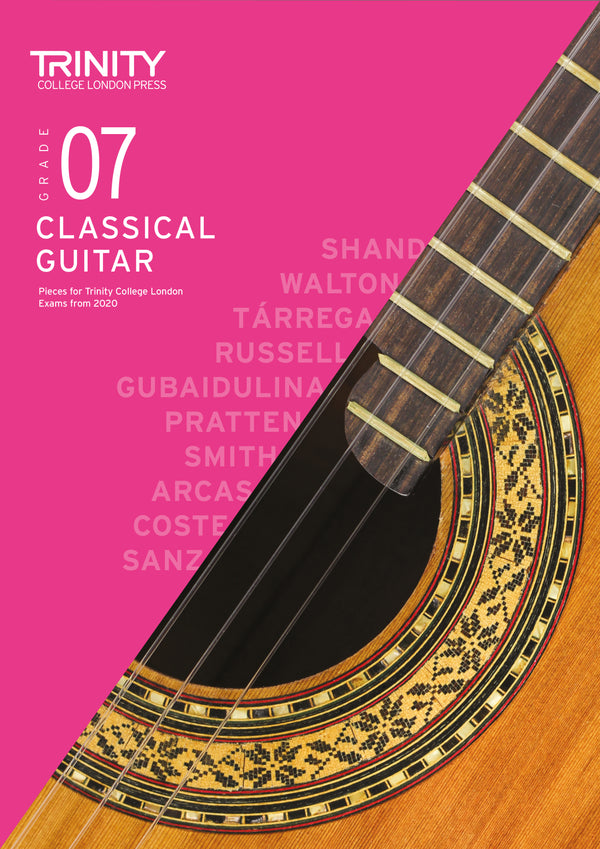
Trinity Classical Grade 7 guitar
Demanding works requiring stamina, memory and stagecraft.
Trinity exams are taken digitally by default — recorded and submitted online — with in-person exams arranged for students who prefer them.
Set pieces
Tap any piece to open its own page with a play-along video, amp settings and practice tips. You'll still need the official grade book for the notation.
Every piece across all Trinity Classical Grade 7 books(28)
- Group AGavotte 1 (from Lute Suite in A minor, BWV 995)— Bach, J S, arr. KoonceThe Solo Lute Works — Kjos WG100 Play
- Group APrelude (from Cello Suite no. 1, BWV 1007)— Bach, J S, arr. KoonceCello Suites 1, 2, 3 — Productions d'Oz DZ2420 Play
- Group ACaprice no. 4 in A minor— Carcassi6 Caprices, op. 26 — Schott GA72 Play
- Group ATarantelle— CosteClassical Guitar Exam Pieces from 2020: Grade 7 — Trinity TCL019349 Play
- Group AAndante cantabile (2nd movt from Sonata in C major, op. 29 no. 1)— Diabelli3 Sonatas — Schott GA57 Play
- Group AAndantino (no. 6 from Colección 4a)— Ferrer24 Estudios — Schott GA569 Play
- Group ARondo (no. 2 from 3 Rondos, op. 17)— GiulianiRondo (no. 2 from 3 Rondos, op. 17) — Araniti (download) Play
- Group AFantasia— HolborneRaise the Bar Guitar: Grades 6-8 — Trinity TCL016577 Play
- Group AAdagio con dolore and Allegro conspirito (from Flowers of my Homeland)— MertzThe Guitarist's Collection book 1 — Mayhew 3611140 Play
- Group AForgotten (no. 77 Impromptu)— PrattenClassical Guitar Exam Pieces from 2020: Grade 7 — Trinity TCL019349 Play
- Group APavanas por la D (from Instrucción de música sobre la guitarra española)— Sanz, arr. KoenigsClassical Guitar Exam Pieces from 2020: Grade 7 — Trinity TCL019349 Play
- Group ASonata in A, K 208— Scarlatti, trans. Burley8 Sonatas — Schott ED12442 Play
- Group ABagatelle, no. 2— SorMes Ennuis: 6 Bagatelles, op. 43 — Ut Orpheus CH283 Play
- Group AThe Bonnie, Bonnie Banks of Loch Lomond— Trad., arr. RussellClassical Guitar Exam Pieces from 2020: Grade 7 — Trinity TCL019349 Play
- Group BBolero— ArcasClassical Guitar Exam Pieces from 2020: Grade 7 — Trinity TCL019349 Play
- Group BBarcarolle (Julia Florida)— Barrios MangoréRaise the Bar Guitar: Grades 6-8 — Trinity TCL016577 Play
- Group BUn dia de noviembre— BrouwerUn dia de noviembre — Chester CH61839 Play
- Group BLes balancelles— DyensSeparately or Les 100 de Roland Dyens vol. 1 — Productions d'Oz DZ1923 or DZ2201 Play
- Group BEtude no. 19: Les moulines marinières— Garcia25 Etudes Esquisses — Mel Bay 95430 Play
- Group BSerenade— GubaidulinaClassical Guitar Exam Pieces from 2020: Grade 7 — Trinity TCL019349 Play
- Group BAzul— MonteroTres colores porteños — Piles PIL1590 Play
- Group BSons de Carilhões (version 2)— PernambucoFamous Chôros vol. 1 — Chanterelle ECH0761 Play
- Group BTango final— Piazzolla, arr. RyanPlay Piazzolla — Boosey M060119712 Play
- Group BLégende, op. 201— ShandClassical Guitar Exam Pieces from 2020: Grade 7 — Trinity TCL019349 Play
- Group BHalcyon Days— SmithClassical Guitar Exam Pieces from 2020: Grade 7 — Trinity TCL019349 Play
- Group BRosita— TárregaClassical Guitar Exam Pieces from 2020: Grade 7 — Trinity TCL019349 Play
- Group BPrélude no. 3 in A minor (play without DS. Omit final andante and go straight to coda)— Villa-LobosCinq préludes — Eschig DF15722 Play
- Group BBagatelle no. 2 (from Five Bagatelles for Guitar)— WaltonClassical Guitar Exam Pieces from 2020: Grade 7 — Trinity TCL019349 Play
Books and exam booking
The Trinity Grade 7 book and the exam booking both come from Trinity College London directly.
Technical work at Grade 7
- Full scale and arpeggio system at tempo
- Extended tremolo and rasgueado
- Complex polyphonic textures
- Historically informed interpretation
What's in the exam
- Three pieces from the syllabus
- Technical work
- One supporting test
- Musical knowledge
Trinity Classical Grade 7 technical work in full
Everything below is published in Trinity's book Guitar Scales, Arpeggios and Studies from 2016: Grades 6–8. You always play the technical exercise, then choose one of: scales & arpeggios set A, scales & arpeggios set B, or the studies. Tell the examiner your choice on the submission form.
1. Technical exercise
Technical exercise in B major (♩ = 102) — music may be used.
- Major tonal centre: major scale, then major arpeggio
- Minor tonal centre: harmonic minor scale, melodic minor scale, then minor arpeggio
2. Scales & arpeggios — set A
From memory, mf.
- B♭ major tonal centre — two octaves, scale im apoyando. Minimum tempi: scales ♩ = 122, arpeggios ♩. = 66
- D minor tonal centre — two octaves, scales ma tirando
- F major tonal centre — three octaves, scale im apoyando
- Chromatic scale starting on F — three octaves, ma
- B♭ major scale in tenths — one octave, pi/pm. Minimum tempo ♩ = 100
- D harmonic minor scale in thirds — two octaves, im
- Dominant 7th arpeggio in the key of F major — two octaves, ppimim…
3. Scales & arpeggios — set B
From memory, mf.
- C major tonal centre — two octaves, scale im apoyando. Minimum tempi: scales ♩ = 122, arpeggios ♩. = 66
- B♭ minor tonal centre — two octaves, scales ma tirando
- F major tonal centre — three octaves, scale im apoyando
- Chromatic scale starting on F — three octaves, ma
- C melodic minor scale in octaves — one octave, pi/pm. Minimum tempo ♩ = 100
- D major scale in sixths — two octaves
- Diminished 7th arpeggio starting on F — three octaves, ppimim…
4. Studies
Choose and perform two studies, each from a different group. Music may be used.
Group 1 — for tone and phrasing
- Cap Gris Nez
- Rain Tree
Group 2 — for articulation
- White Water
- Modes of Thought
Group 3 — for idiomatic elements
- Mezquito
- Night Vision